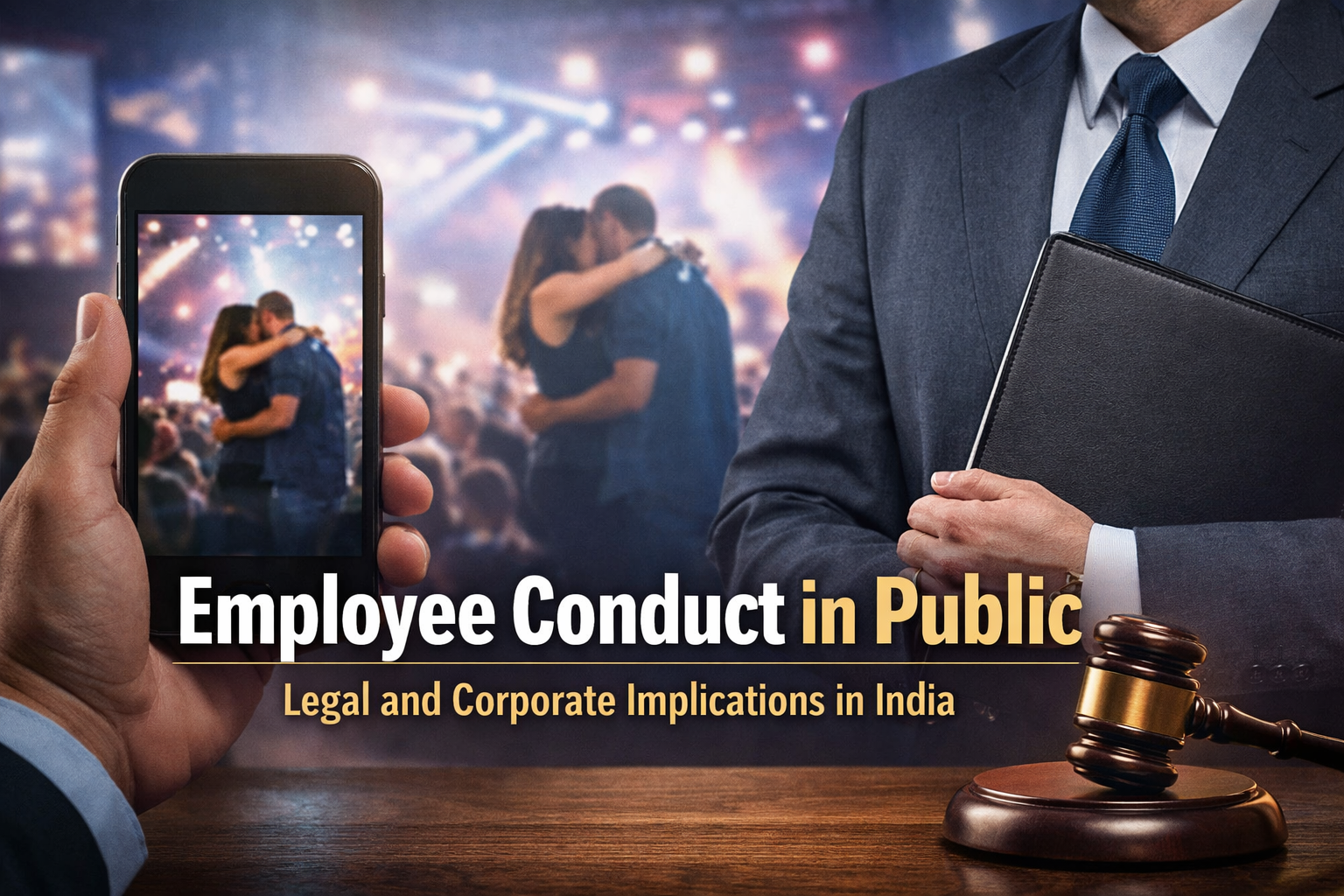
Caught on Camera: Legal Repercussions and Corporate Implications of Public Conduct by Employees in India
Introduction
In an age dominated by smartphones, social media, and mass entertainment events, the boundary between personal life and professional responsibility is increasingly porous. Incidents—whether hypothetical or real—where corporate employees are captured on camera at public events, such as concerts or festivals, raise important legal and ethical questions.
Consider a scenario involving a senior executive and an HR professional being filmed at a public concert. Even if the interaction is consensual and personal, its public visibility may trigger scrutiny from employers, shareholders, and the wider public. This leads to critical legal questions within the Indian legal framework:
-
Can an employer legally take action against employees for conduct at a public event?
-
Do privacy rights protect employees from disciplinary action?
-
Does the Companies Act, 2013 permit intervention in such matters?
-
How do workplace ethics, POSH obligations, and employment contracts intersect?
This article analyses these questions through constitutional principles, corporate and labour laws, judicial precedents, and internal governance mechanisms, with a focus on Indian law.
Privacy in Public Places: Constitutional and Statutory Limits
The right to privacy is constitutionally protected under Article 21 of the Indian Constitution. Its contours were authoritatively defined by the Supreme Court in Justice K.S. Puttaswamy (Retd.) v. Union of India. The Court recognised privacy as intrinsic to dignity and personal autonomy, while clarifying that the right is not absolute.
Importantly, the Court noted that the expectation of privacy varies with context. In private spaces such as homes or hospitals, privacy expectations are high. In contrast, public venues—stadiums, streets, concerts—carry a significantly reduced expectation of privacy, particularly where individuals voluntarily participate in large public gatherings.
From a statutory standpoint, recording a person in a public place is not per se illegal. Provisions under the Indian Penal Code relating to defamation may apply only if the recording is circulated with malicious intent to harm reputation. Similarly, the Information Technology Act, 2000 protects against intrusive or voyeuristic recording, but ordinary non-sexual recordings at public events generally fall outside its prohibitions.
Thus, Indian law does not treat non-explicit, consensual public conduct as a privacy violation merely because it was captured on camera.
Employee Conduct and Corporate Obligations under the Companies Act, 2013
The Companies Act, 2013 primarily governs corporate governance, disclosures, and fiduciary obligations. Under Section 166, directors and certain senior personnel are required to act in good faith, avoid conflicts of interest, and protect the company’s reputation.
Where a director or senior executive is involved in conduct that leads to reputational harm, shareholder concern, or internal instability, the company may justify initiating an internal inquiry. However, such action must be rooted in demonstrable corporate impact—not moral discomfort.
HR professionals, in particular, occupy a sensitive position of trust. Publicly visible personal relationships with reporting superiors may raise concerns about bias, favoritism, or conflict of interest. That said, the Companies Act does not criminalise personal relationships. Any disciplinary action must flow from internal codes of conduct, service rules, or employment contracts, not from the statute itself.
Indian courts have consistently cautioned against arbitrary action based on public morality alone. Unless the conduct demonstrably affects business operations or violates contractual obligations, punitive measures may not withstand legal scrutiny.
POSH Act, 2013: Where Personal Conduct Intersects Workplace Law
The Sexual Harassment of Women at Workplace (Prevention, Prohibition and Redressal) Act, 2013 is designed to ensure safe working environments. While a concert or public event is not a “workplace” per se, the Act becomes relevant if:
-
A complaint is raised alleging abuse of authority
-
The conduct suggests quid pro quo harassment
-
Workplace decisions appear influenced by a personal relationship
Consensual conduct in a public space, in the absence of a complaint, does not amount to sexual harassment. However, organisations are legally obligated to act if allegations arise linking personal conduct to workplace prejudice, promotions, evaluations, or intimidation.
Employers must strike a careful balance: respecting private autonomy while ensuring fairness, neutrality, and a non-hostile work environment.
Information Technology Act, 2000 and Circulation of Visual Content
The Information Technology Act, 2000 addresses cyber offences and electronic content dissemination. Sections dealing with privacy and obscenity apply primarily where content is sexually explicit, intrusive, or published with malicious intent.
Public recordings from concerts or events—absent nudity, sexual acts, or voyeuristic focus—generally do not attract liability under the Act. That said, organisations may legitimately restrict the circulation or discussion of such videos on internal platforms to prevent gossip, harassment, or workplace discomfort.
Standing Orders, Employment Contracts, and Misconduct
Under Indian labour law, disciplinary action must be grounded in clearly defined misconduct under:
Typically, misconduct clauses may include “indecent behaviour,” “acts bringing disrepute to the company,” or “conduct outside the workplace affecting organisational reputation.” However, courts insist on a direct nexus between the conduct and workplace harm.
Absent evidence of financial loss, operational disruption, or contractual breach, disciplinary action may be challenged as wrongful termination or unfair labour practice under the Industrial Disputes Act, 1947.
Judicial Approach to Personal Morality and Employment
Indian jurisprudence consistently rejects employer-imposed moral policing. Courts have held that personal conduct cannot be regulated unless it materially affects professional duties or public interest.
Termination or punishment based solely on moral assumptions, without due inquiry and evidence, violates principles of natural justice. Employers must demonstrate proportionality, reasonableness, and procedural fairness.
Conclusion
Being captured on camera at a public event—even in a controversial or intimate moment—does not automatically justify disciplinary action under Indian law. The Companies Act, 2013, Information Technology Act, 2000, and POSH Act, 2013 permit intervention only where there is:
-
Breach of fiduciary duty
-
Workplace harassment or abuse of authority
-
Violation of contractual or ethical obligations
-
Demonstrable harm to the organisation
Indian law favours individual autonomy over moral surveillance. Corporate governance must be guided by fairness, documented policies, and legal proportionality—not subjective notions of propriety.
Incase, You wish to discuss, and talk on any such matter that, ‘You may need help with‘. Feel free to contact our team at https://legalwellbeing.in/contact-us/ who shall be happy to assist. Written by Team Member(s) and Ms. Aparna Mishra.
Disclaimer: –The information provided on this website is for general informational and educational purposes only; Involves Content assistance and structuring supported by AI tools. It does not constitute legal advice and should not be relied upon as such. Accessing or using this website does not create a lawyer-client relationship.