Robotic Surgery: Legal, Ethical & Practical Implications in India
Introduction
The use of robotics and artificial intelligence (AI) in healthcare is expanding rapidly, both in India and worldwide. Robotic surgery represents a major evolution in medicine, combining medical science, engineering, robotics, and legal considerations. It is a complex technique that uses specialized robotic platforms to help surgeons perform highly precise and minimally invasive procedures.
A typical robotic surgery setup involves two major components:
- The Surgeon’s Master Console
- The Patient-Side Robotic System
The surgeon operates from the master console, which provides a high-definition 3D view of the surgical field. Using hand controllers or joysticks, the surgeon’s movements are translated into real-time, precise actions by robotic arms positioned above the patient.
Robotic Surgery in India
According to current data from hospitals and health institutions, nearly 28–30 hospitals in India now use robotic surgery systems. While many Indians remain hesitant due to misconceptions about risks, several international patients prefer India for robotic procedures due to significantly lower costs.
- India: USD 2,500 – 15,000
- USA: Approx. USD 200,000
This stark cost difference makes India a growing hub for medical tourism in robotic surgery.
Informed Consent in Robotic Surgery
Informed consent is a critical legal and ethical requirement for robotic surgeries. It builds trust between surgeons and patients, ensures transparency, and protects both parties in cases of medical malpractice claims.
Under the Indian Medical Council (Professional Conduct, Etiquette and Ethics) Regulations, 2002 (Section 7.16), any experimental or advanced procedure—including robotic-assisted surgery—must be fully explained to the patient. Consent must be:
- Clear and detailed
- Given in a language understood by the patient and their family
- Inclusive of all risks, including potential robot malfunction or system failure
Although robotic surgery does not require a separate consent form, the participation of a robotic system and related risks must be mentioned explicitly.
Liability in Robotic Surgery
Liability in robotic surgery is more complex than in traditional surgery. It can fall on:
- The Surgeon
- The Hospital/Healthcare Facility
- The Manufacturer of the Robotic System
1. Liability of the Surgeon
The surgeon remains the primary decision-maker and operator. Even though the robot assists, the surgeon directs every action. Liability questions arise when:
- A mechanical or software failure occurs
- The surgeon lacks adequate training
- There is uncertainty whether the error was human or machine-driven
If the surgeon is insufficiently trained or negligent, they can be held liable. However, if the failure results from a system defect, liability may shift elsewhere.
2. Liability of Hospitals
Hospitals play a crucial role in ensuring:
- Proper maintenance of robotic systems
- Adequate training for surgeons
- Safe infrastructure and sterile environments
Hospitals may be liable if:
- The robot malfunctions due to poor maintenance
- They allow untrained staff to operate robotic systems
- System errors occur due to infrastructural negligence
3. Liability of Manufacturers
Manufacturers may be liable for:
- Defects in design, software, or hardware
- Lack of proper instructions or warnings
- Failure to conduct required clinical investigations
Under the Medical Device Rules, 2017, robotic systems classified as Class C or D (High-Risk Devices) must meet stringent safety standards. Manufacturers can be sued for defective equipment if harm occurs.
Consumer Protection Act & Robotic Surgery
Under the Consumer Protection Act, 2019, patients are considered consumers. Robotic surgical errors can qualify as:
- “Deficiency in service” (Section 2(11))
- “Product liability” claims against manufacturers (Sections 82–87)
Patients can file claims if:
- The surgeon lacks competency
- The hospital fails to meet required standards
- The robotic system is faulty
Insurance Challenges
Insurance disputes are common due to unclear liability. Traditional insurance models assumed human error, not machine-assisted procedures. Many Indian policies:
- Avoid covering robotic surgery
- Classify it as experimental
- Reject claims due to unclear accountability
The IRDAI Health Regulations (2019) require coverage of “modern treatments,” including robotic surgery, though many policies still have sub-limits or ambiguities.
Example: Insurance Denial Case
K. P. Sinh Rathod v. Oriental Insurance Co. Ltd.
A patient was reimbursed only a fraction of his robotic surgery cost. The court ruled that denial was unjustified and ordered compensation with interest.
Case Involving Injury During Robotic Surgery
Ujjawal Chaudhary v. Yashoda Super Speciality Hospital (2025)
A robotic hernia repair lasted excessively long, leading to bowel perforation, complications, and eventual death. The case raised:
- Questions about surgeon oversight
- Accuracy of robotic systems
- Post-operative monitoring failures
It also highlighted insurance-related challenges for robotic surgery complications.
Role of Media Personnel
Media coverage of robotic surgeries must comply with:
- Patient consent requirements
- MCI/NMC ethical guidelines
- Right to Privacy (Article 21, Puttaswamy judgment)
- Data protection obligations under the Digital Personal Data Protection Act, 2023
Unauthorized recording or disclosure can lead to legal consequences.
Role of Doctors in Robotic Surgery
Surgeons remain:
- The primary operators
- Legally responsible for outcomes
- Required to obtain informed consent
- Expected to have proper credentials and training
Robotic systems enhance precision, but legal accountability stays with the human surgeon.
Role of Hospitals
Hospitals must:
- Maintain robotic surgical systems
- Ensure proper training and credentialing
- Comply with biomedical and data protection laws
- Ensure ethical informed consent processes
Under vicarious liability, hospitals can be held responsible for staff negligence.
Role of Hospital Administration
Hospital administration must:
- Ensure robotic systems meet safety and regulatory standards
- Maintain equipment under Clinical Establishments Act, 2010
- Implement strict consent and safety protocols
- Ensure data protection compliance
- Permit only trained professionals to operate robots
Systemic administrative failure can result in institutional liability.
Role of Manufacturers
Manufacturers must:
- Comply with the Medical Devices Rules, 2017
- Provide adequate warnings and instructions
- Ensure product safety, updates, and maintenance
- Meet data protection and cybersecurity standards
- Provide training and technical support
Failure to do so can lead to strict product liability.
Conclusion
Robotic surgery is transforming modern healthcare by improving precision, reducing invasiveness, and enhancing patient recovery. However, its integration in India raises significant legal, ethical, and regulatory challenges.
Liability is more complex than in traditional surgery, involving shared responsibility between surgeon, hospital, and manufacturer. Insurance disputes, unclear regulatory frameworks, and the evolving nature of robotic technology add further complications.
For India to safely adopt robotic surgery on a large scale, reforms must include:
- Clear guidelines on liability
- Standardized informed consent protocols
- Updated insurance frameworks
- Stronger product regulation
- Protection of patient rights and data
Technological progress must be supported by robust legal safeguards to ensure patient safety and accountability.
Incase, You wish to discuss, and talk on any such matter that, ‘You may need help with’. Feel free to contact us. Our team at www.legalwellbeing.in shall be happy to assist.
Written by Team Member(s) and Ms. Aparna Mishra.
Top 10 Tips for Safe & Successful Robotic Surgery Practices
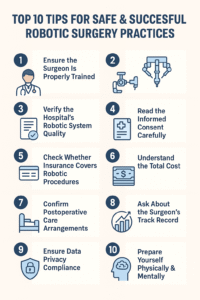
1. Ensure the Surgeon Is Properly Trained
Always check that the doctor has formal certification and hands-on experience in robotic surgery.
2. Verify the Hospital’s Robotic System Quality
Choose hospitals with well-maintained, updated robotic systems and trained staff.
3. Read the Informed Consent Carefully
Make sure the consent form clearly explains risks, benefits, and the role of the robot.
4. Ask About Backup Plans
Confirm that the surgical team has a plan in case the robot malfunctions during surgery.
5. Check Whether Insurance Covers Robotic Procedures
Many insurance companies apply sub-limits or exclusions—clarify this beforehand.
6. Understand the Total Cost
Robotic surgery can be more expensive; ask for a detailed breakdown of hospital and equipment charges.
7. Confirm Postoperative Care Arrangements
Good monitoring after surgery reduces complications—ensure the hospital has proper protocols.
8. Ask About the Surgeon’s Track Record
Knowing the surgeon’s success rates and number of robotic procedures performed builds confidence.
9. Ensure Data Privacy Compliance
Robotic systems collect data—verify that the hospital protects your personal health information.
10. Prepare Yourself Physically & Mentally
Follow pre-surgery instructions, stay informed, and discuss any concerns with your surgeon.