Introduction
Termination of a commercial contract does not necessarily end the financial relationship between the parties. In construction, engineering and supply contracts, the real dispute may begin after termination. A buyer may appoint another contractor, incur additional expenditure and later seek to recover that amount from the original contractor. The recovery may appear in the final account as “back-charges”, “risk-and-cost charges”, “rectification costs” or “liquidated damages”.
The difficulty is that a label does not by itself establish a legal right to deduct money. The buyer must still show the contractual basis of the charge, the breach that triggered it and, where necessary, the loss or compensation legally recoverable for that breach. This becomes particularly important where the contractor is an MSME and the buyer seeks to deduct a disputed amount from money otherwise payable to it.
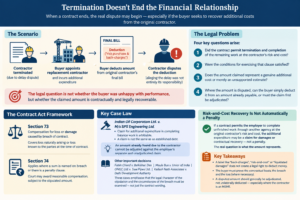
Consider a simple illustration. An engineering contractor is terminated after a dispute over delay. The buyer appoints a replacement contractor and, several months later, deducts a substantial amount from the original contractor’s final bill, describing it as “risk purchase and back-charges”. The contractor disputes the deduction and says that the buyer never established that the alleged delay was entirely its responsibility.The legal question is therefore not simply whether the buyer was dissatisfied with the contractor’s performance. It is whether the claimed amount is contractually and legally recoverable.
The Legal Problem
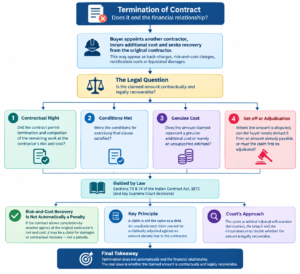
Four questions generally arise. First, did the contract permit termination and completion of the remaining work at the contractor’s risk and cost? Secondly, were the conditions for exercising that clause satisfied? Thirdly, does the amount claimed represent a genuine additional cost or merely an unsupported estimate? Finally, where the amount is disputed, can the buyer simply deduct it from an amount already payable, or must the claim first be adjudicated?
The Supreme Court’s decision in Indian Oil Corporation Ltd. v. M/s SPS Engineering Ltd. provides a useful starting point. Indian Oil Corporation had awarded infrastructure work relating to the drinking water system of its Paradip Refinery project to SPS Engineering Ltd. The contract was terminated after the employer alleged inadequate progress. IOCL stated that the remaining work would be completed through an alternative agency at the contractor’s risk and cost.SPS Engineering subsequently pursued its claims, while IOCL sought to pursue its claim for additional expenditure incurred in completing the balance work. The immediate issue before the Supreme Court concerned the arbitrability of IOCL’s claim. The Court held that the claim for additional expenditure incurred in completing the balance work could be raised in arbitration.
The significance of the decision lies in the distinction between a claim and an established debt. An amount already found due to the contractor could not simply be adjusted against the employer’s separate and unadjudicated claim for damages. IOCL was entitled to pursue its claim, but the existence of that claim did not automatically convert it into an ascertained amount available for unilateral adjustment.
This distinction is important in commercial disputes. A buyer may genuinely believe that it has suffered loss because of a contractor’s breach. That belief, by itself, does not transform the alleged loss into a debt that can automatically be deducted from the contractor’s bill.
The Contract Act Framework
Sections 73 and 74 of the Indian Contract Act, 1872 provide the basic framework for contractual compensation. Section 73 deals with compensation for loss or damage caused by breach of contract. It broadly concerns loss naturally arising from the breach or loss which the parties knew, when they entered into the contract, was likely to result from the breach.
Section 74 applies where a contract names a sum payable on breach or contains another stipulation by way of penalty. The provision does not simply enforce every contractual figure as an automatically recoverable debt. The court may award reasonable compensation, subject to the stipulated amount.
The Supreme Court explained this principle in Fateh Chand v. Balkishan Das. It subsequently considered the subject in Maula Bux v. Union of India and ONGC Ltd. v. Saw Pipes Ltd. These decisions demonstrate that contractual wording is important, but the legal character of the stipulation and circumstances of the breach must also be examined.
In the case of Kailash Nath Associates v. Delhi Development Authority the Supreme Court emphasised that compensation under Section 74 must be reasonable and that the provision cannot be used to justify an unjustified recovery merely because a contract contains a stipulated amount. The relationship between the stipulated sum, the breach and the existence of loss remains relevant.
Therefore, a buyer cannot make a weak claim stronger merely by calling it “liquidated damages” or “back-charges”. The court or arbitral tribunal may still have to examine the contract, the breach and the circumstances in which the amount became payable.
Risk-and-Cost Recovery Is Not Automatically a Penalty
There is an important qualification. Not every risk-and-cost claim is a penalty under Section 74. If a contract validly permits the employer to have unfinished work completed by another agency at the original contractor’s risk and cost, the additional expenditure may constitute a claim for damages or contractual recovery rather than a penalty. The real question is what the amount represents.
If a contractor leaves a part of the work unfinished and the buyer has to spend substantially more than the original contract price to complete that work, the buyer may have a legitimate claim for the additional cost, subject to the contract and proof of the relevant facts. But the buyer cannot automatically assume that every expenditure incurred after termination was caused by the original contractor.
A recent illustration is Indian Oil Corporation Ltd. v. Toyo Engineering Corporation. The dispute arose from a large engineering contract and included a specific issue concerning “Back Charges”. The Delhi High Court examined the contractual framework, deductions and arbitral findings under the limited scope of Section 34 of the Arbitration and Conciliation Act, 1996. The Court ultimately declined to interfere with the arbitral award.
The case is useful not because it establishes that back-charges are always valid, but because it shows the importance of the contractual machinery governing deductions and the evidence supporting the parties’ competing positions. The Court also recognised that a plausible interpretation of contractual provisions by an arbitral tribunal is not ordinarily to be substituted merely because another interpretation is possible.
Unilateral Deduction and Counterclaims
This is where the distinction between a counterclaim and a unilateral deduction becomes practically significant.
A buyer may have a genuine claim against a contractor. But a claim is not necessarily the same thing as an admitted debt. If the contractor disputes the breach, causation, quantum or contractual right to deduct, the buyer may need to establish its entitlement through the agreed dispute-resolution mechanism.
SPS Engineering illustrates this distinction. IOCL’s claim for additional completion expenditure was not rejected merely because it was a claim by the employer. The Supreme Court recognised its arbitrability. At the same time, the existence of that claim did not mean that IOCL could simply treat the disputed amount as equivalent to an amount already adjudicated as payable by the contractor.This distinction is particularly important where a final bill contains several deductions but the contractor has not been provided with supporting calculations, invoices or evidence explaining how each deduction was reached.
MSME Dimension
Where the contractor is a micro or small enterprise covered by the MSMED Act, 2006, the dispute may also engage the special statutory framework concerning delayed payments.
Section 15 requires a buyer to make payment for goods or services within the statutory framework and limits an agreed written payment period to 45 days from acceptance or deemed acceptance. Section 16 provides for statutory interest where the buyer fails to make payment as required. Sections 17 and 18 provide the recovery and dispute-resolution framework, including reference to the Micro and Small Enterprises Facilitation Council.
The MSMED Act does not mean that every contractual defence or counterclaim of a buyer disappears merely because the supplier is an MSME. In M/s Silpi Industries v. Kerala State Road Transport Corporation, the Supreme Court held that counterclaims and set-offs are maintainable before the statutory authorities in proceedings under Section 18 of the MSMED Act. The Court relied on the interaction between Section 18(3) of the MSMED Act and Section 23(2-A) of the Arbitration and Conciliation Act, 1996.This is important for both sides. An MSME supplier cannot assume that the buyer is legally barred from raising a genuine counterclaim. Equally, a buyer cannot treat the availability of a counterclaim as permission to make an unsupported deduction without following the applicable contractual and statutory framework.
NBCC (India) Ltd. v. State of West Bengal, 2025 INSC 54, provides a recent discussion of the statutory scheme of the MSMED Act and its interaction with arbitration law. It also revisited the earlier jurisprudence concerning the statutory dispute-resolution mechanism under Section 18.
Practical Application
Returning to the fictional contractor, the buyer’s position would be considerably stronger if its records showed a valid termination, a contractual risk-and-cost clause, proof of the contractor’s breach, a properly documented replacement contract and a calculation showing the actual additional cost attributable to completing the unfinished work.
The position would be weaker if the buyer merely prepared an internal debit note after termination and deducted a round figure from the final bill. It would be even more problematic if the deduction included unrelated administrative expenses, costs caused by the buyer’s own delay, amounts already covered by another contractual remedy or losses that had never been established.
For an MSME contractor, the practical response should begin with documents. The contractor should preserve the work order, termination notice, correspondence concerning delay, site instructions, measurement records, invoices, payment statements and objections to deductions. It should ask the buyer to identify the contractual clause and provide the calculation and supporting documents for each disputed charge.
For buyers, the lesson is equally practical. A risk-and-cost clause should not be treated as a blank cheque. Before making a deduction, the buyer should establish the contractual trigger, document the breach, maintain records of the replacement work and calculate the additional cost carefully. If the amount is disputed, the buyer should consider presenting it as a counterclaim in the appropriate proceedings rather than assuming that an internal debit note conclusively establishes liability.
Conclusion
Post-termination back-charges sit at the intersection of contract law, damages and dispute resolution. The law does not make such charges automatically invalid merely because they are imposed after termination. Nor does the use of terms such as “risk and cost”, “back-charge” or “liquidated damages” automatically make the amount recoverable.
The stronger legal position is one supported by a clear contractual clause, a valid contractual breach, a demonstrable connection between the breach and the additional expenditure, and a proper process for resolving any dispute about the amount. Where the contractor’s liability remains disputed, the buyer’s claim may require adjudication rather than unilateral adjustment.
For an MSME contractor, the central lesson is that termination does not automatically extinguish outstanding payment claims. For the buyer, MSME status does not automatically extinguish a genuine contractual counterclaim. The important question is whether the alleged back-charge is a legally recoverable claim or merely a disputed amount dressed up as a deduction. That distinction can determine whether the final account becomes a routine commercial adjustment or the beginning of a larger arbitration or MSME dispute.