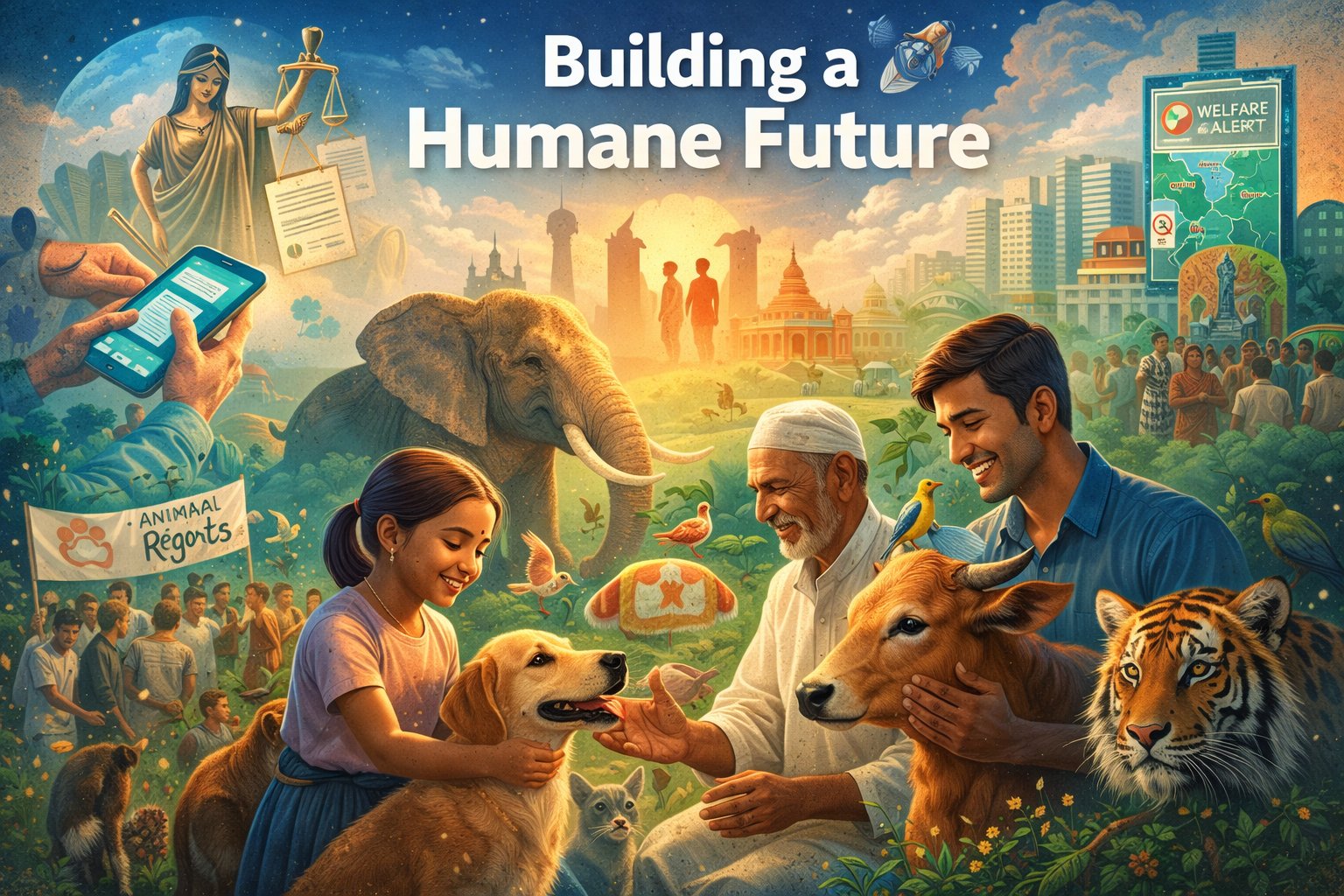
Building a Humane Future
Introduction
India has one of the world’s oldest legal frameworks for animal welfare, yet the condition of animals continues to expose deep gaps between policy and practice. Laws such as the Prevention of Cruelty to Animals Act, 1960, and the Wildlife Protection Act, 1972, were landmark steps that reflected a growing recognition of animals as sentient beings. However, over time, these laws have struggled to address the changing realities of urbanization, industrialization, and public indifference. Implementation remains uneven across states, penalties are often outdated, and enforcement depends heavily on individual initiative rather than systemic accountability.
This gap between legislation and lived reality shows that the problem is not only legal but also psychological and social. Attitudes toward animals are shaped by economic priorities, cultural traditions, and the human tendency to separate empathy from responsibility. Many people feel compassion for animals yet justify cruelty when it benefits human convenience, livelihood, or entertainment. Such contradictions reveal that cruelty is often not born from malice but from moral distance and social conditioning. Bridging this distance requires education and awareness that extend beyond urban activism to include rural communities, schools, and faith institutions.
Education and psychoeducation can play a vital role in nurturing compassion as a social value rather than a private emotion. When children learn early about animal sentience, interdependence, and kindness, they are less likely to accept cruelty as normal. Similarly, public campaigns explaining the emotional and ecological importance of animals can reshape collective attitudes. Alongside education, technology offers new ways to make animal welfare more transparent and accessible. Digital tools for reporting abuse, monitoring welfare, and spreading awareness can connect citizens, NGOs, and local authorities more effectively. However, technology must remain inclusive and ethical, serving as a bridge between people and animals rather than a tool for control.
As India prepares to modernize its welfare systems, the future of reform depends on combining empathy, innovation, and good governance. Policy must not only protect animals through punishment but also encourage a culture of compassion supported by knowledge and participation. Building a humane future will require collaboration between educators, technologists, policymakers, and citizens. Only when compassion becomes both a social and institutional priority can India move toward a model of welfare that reflects its moral and cultural promise—one that values the lives of all beings who share this land.
Psychosocial Barriers to Welfare Reform
Animal welfare outcomes emerge fundamentally from public consciousness, moral reasoning, and educational preparation. To understand this, it is necessary to examine the cognitive barriers preventing comprehensive animal protection, the current state of humane education in India, and evidence-based psychoeducational interventions that can transform public attitudes and behaviors across generations.
A variety of psychological mechanisms maintain selective moral consideration of animals, creating resistance to welfare reforms even among individuals who express concern for animal suffering.
One such mechanism is speciesism—the assignment of different moral worth based on species membership. This hierarchy manifests in everyday moral judgments. For example, many Indians express horror at the idea of eating dogs but consume chicken without moral discomfort, despite comparable sentience. Speciesism often operates unconsciously. Individuals do not consciously decide that some animals deserve protection while others do not. Instead, cultural norms, economic arrangements, and socialization processes normalize differential treatment as natural.
Research shows these hierarchies are learned rather than innate, meaning they can also be unlearned through education and intervention.
Cognitive Dissonance and Moral Justification
Cognitive dissonance theory, developed by Leon Festinger (1957), explains how individuals manage psychological discomfort caused by contradictions between beliefs and actions. Urban middle-class individuals may love companion animals while remaining indifferent to working animal suffering. To resolve this conflict, the mind uses several coping strategies:
Compartmentalization: Companion animals are viewed as “family,” while working animals are seen as “resources,” preventing moral comparison.
Rationalization: Narratives such as “they are bred for labor” or “farmers have no choice” justify exploitation as necessary.
Selective attention: Individuals avoid thinking about invisible suffering, preventing moral discomfort.
Moral disengagement: Mechanisms such as euphemistic labeling (“using” instead of “exploiting”), diffusion of responsibility (“everyone does it”), and emotional distancing reduce feelings of ethical responsibility.
These strategies allow individuals to maintain a positive self-image while participating in or tolerating harmful systems.
The Just-World Hypothesis
The just-world hypothesis, proposed by Melvin Lerner (1980), describes the human tendency to believe that the world is fair and that individuals get what they deserve. Applied to animals, this belief leads people to justify suffering as natural or necessary.
Common examples include:
- “They are meant to work.”
- “Owners depend on them economically.”
- “This is how things have always been.”
Such thinking protects psychological comfort while normalizing injustice.
Economic Rationalization
Economic rationalization presents animal exploitation as necessary for human survival. This framing positions animal welfare as a luxury rather than a necessity.
Examples include:
- “I cannot afford veterinary care.”
- “Our livelihood depends on animal labor.”
- “Transition costs are too high.”
While economic dependence is real, it reflects structural limitations rather than inevitable realities. Sustainable reform must support both human livelihoods and animal welfare simultaneously.
The Role of Education and Awareness
Humane education fosters compassion, ethical awareness, and responsible behavior toward animals. Research shows that humane education improves empathy, emotional intelligence, and social responsibility.
Programs such as school-based humane education initiatives have reached millions of children across India. These programs help preserve children’s natural empathy and prevent desensitization to cruelty.
However, major gaps remain:
- Rural areas receive limited outreach.
- Adult education programs are rare.
- National-scale awareness campaigns are lacking.
- Cultural sensitivity is often insufficient.
Effective humane education must be inclusive, culturally relevant, and accessible across communities.
Psychoeducation as Intervention
Psychoeducation combines information, emotional engagement, and behavioral training to transform attitudes and actions.
Effective methods include:
- Perspective-taking exercises
- Direct interaction with animals in safe environments
- Story-based emotional engagement
- Cross-species empathy training
These interventions help individuals expand their moral circle and develop lasting compassionate behaviors.
Technology as a Catalyst for Change
Technology offers powerful tools for improving animal welfare, including:
Digital reporting platforms
Citizens can report abuse using mobile applications.
GPS tracking systems
Working animals can be monitored to prevent overwork and neglect.
Artificial intelligence analysis
AI can identify patterns of abuse and improve intervention efficiency.
Social media awareness campaigns
Digital platforms amplify visibility and mobilize public action.
However, technology must remain ethical, affordable, and accessible.
Challenges and Ethical Considerations
Technology-based welfare systems face several challenges:
- Economic barriers to adoption
- Digital inequality between urban and rural areas
- Privacy and surveillance concerns
- Risk of misuse or data exploitation
Technology must complement human compassion, not replace it.
International Lessons: Bhutan’s Success
Bhutan provides a powerful example of successful animal welfare reform through:
- Strong political commitment
- Nationwide coordination
- Community participation
- Technology integration
- Clear goals and timelines
This demonstrates that systemic reform is achievable through unified national effort.
The Psychology of Selective Compassion
Human compassion is often selective. People empathize more with animals that are familiar, visible, or emotionally relatable.
Working animals and livestock often remain invisible within moral consideration.
Psychological mechanisms contributing to selective compassion include:
- Moral compartmentalization
- Emotional distancing
- Cultural normalization
- Media visibility bias
Overcoming these barriers requires education, awareness, and sustained cultural change.
Conclusion
The future of animal welfare in India depends on bridging the gap between empathy and action. Laws alone cannot transform society without psychological and cultural change.
Humane education, psychoeducation, and ethical technology offer pathways toward lasting reform.
International examples show that progress is possible when compassion becomes a national priority.
India’s path forward lies in integrating law, education, technology, and social awareness to create a humane society that respects all sentient life.
Only when compassion becomes a collective responsibility—not an individual choice—can India truly build a humane future.
Ten Key Focus Points
-
Gap Between Law and Reality
Despite strong legal frameworks, enforcement of animal welfare laws in India remains inconsistent, with weak penalties and poor implementation. -
Psychological Roots of Animal Cruelty
Animal suffering persists not only due to legal failures but also because of psychological mechanisms like moral disengagement, rationalization, and social conditioning. -
Speciesism and Moral Hierarchies
Society assigns different moral value to animals based on their species, leading to selective compassion for pets while neglecting working animals and livestock. -
Cognitive Dissonance and Justification
People resolve internal conflict between compassion and exploitation by compartmentalizing animals into categories like “family,” “resource,” or “commodity.” -
Economic Rationalization as a Barrier
Animal exploitation is often justified as economically necessary, especially among vulnerable communities dependent on animal labor. -
Importance of Humane Education
Early education plays a crucial role in shaping empathy, compassion, and ethical responsibility toward animals across generations. -
Psychoeducation as a Transformative Tool
Structured psychoeducational interventions can reshape beliefs, increase empathy, and encourage humane behaviors through emotional and cognitive engagement. -
Technology as a Catalyst for Welfare Reform
Tools like reporting apps, GPS monitoring, AI analysis, and social media can improve transparency, enforcement, and public awareness. -
Selective Compassion and Social Psychology
Public empathy is often driven by visibility, emotional connection, and media coverage, leaving many animals invisible and neglected. -
Need for Integrated Systemic Reform
Sustainable animal welfare requires coordination between law, education, technology, governance, and public participation to build a culture of compassion.