Brick by Brick
The Psychology Behind India’s Invisible Construction Workforce
Introduction
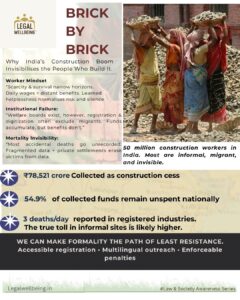
India’s construction sector employs approximately 50 million workers and contributes nearly 9% to the country’s GDP. It is one of the largest workforces globally, yet it operates almost entirely outside formal economic and social protections. Most workers are migrants, informally hired, often without contracts or safety safeguards. Welfare schemes exist in principle; however, enforcement remains weak. Worker deaths occur regularly, yet the available data fails to capture their true scale.
What makes this situation psychologically remarkable is not merely the gap between policy and practice, but the sustained equilibrium surrounding it. Workers continue under hazardous conditions, the middle class continues benefiting from infrastructure without discomfort, and the state continues announcing schemes without ensuring delivery. To understand this equilibrium, one must examine the psychological processes that make such stagnation feel normal to all parties involved.
This includes cognitive biases, coping mechanisms, social norms, and institutional inertia. These mental frameworks allow structural neglect to persist smoothly, year after year, without triggering crisis or transformation. Understanding these mechanisms may also reveal broader truths about how societies normalize inequality.
The Construction Workforce in India: Context and Vulnerability
India’s construction sector employs approximately 50 million workers, making it one of the largest such workforces in the world and contributing around 9% to GDP. This workforce is predominantly migrant. Across industries, an estimated 150 million migrant laborers make up roughly 30% of India’s 500 million workforce, many concentrated in construction due to its labor-intensive nature.
These workers are typically from rural, low-income backgrounds, with high levels of interstate migration. Over 41 million interstate migrants were recorded in older census data, though the true number has likely grown significantly with urbanization. Dependence on migrant labor is acute, as declining rural opportunities push workers toward urban construction sites for survival.
Working and living conditions are precarious. Employment is unstable. Sites are hazardous and often lack basic safety measures. Workers face inadequate sanitation and heightened health risks from dust, chemicals, and extreme weather. Informality dominates, with workers hired through contractors without contracts, resulting in wage irregularities and exploitation.
This creates a stark paradox: invisible laborers build visible progress while remaining trapped in cycles of poverty.
At the psychosocial core lies a survival mindset shaped by intergenerational poverty and learned helplessness. Workers adapt to adversity through stoicism, viewing hardship as inevitable, which further entrenches their vulnerability.
The Worker’s Mindset
Most construction workers are internal migrants who left rural areas due to insufficient agricultural income. Migration is not aspirational—it is economically coerced. Construction becomes the default option because it requires minimal formal qualifications and offers immediate income, despite hazardous conditions, unstable employment, and irregular wages.
Yet the flow of labor continues. This persistence suggests the decision is not purely economic—it is psychological.
Scarcity and Cognitive Bandwidth
Psychological research shows that scarcity reduces cognitive bandwidth—the mental capacity available for long-term planning. For construction workers, survival depends on daily wages. Success is defined by securing today’s income, not by long-term benefits.
A guaranteed ₹500 today outweighs a potential ₹5000 benefit that requires documentation, waiting periods, and bureaucratic navigation. This is not irrationality—it is rational adaptation to uncertainty.
Learned Helplessness and Fatalism
Repeated exposure to uncontrollable negative outcomes produces learned helplessness—a psychological state where individuals stop trying to change their circumstances.
This manifests in passive acceptance of wage theft (“What can we do?”), safety violations (“Accidents happen”), and reluctance to pursue legal remedies (“It won’t change anything”).
These attitudes are reinforced by cultural fatalism, where hardship is attributed to destiny, karma, or social hierarchy. This creates a self-sustaining acceptance: “This is how life is meant to be for people like us.”
Social Comparison and Normalization
Workers compare themselves primarily with peers facing similar hardships. Psychological research shows dissatisfaction arises more from relative deprivation than absolute hardship.
When everyone in one’s reference group suffers similarly, exploitation becomes normalized. Shared suffering becomes psychologically invisible.
Cognitive Dissonance and Identity
Workers reconcile harsh conditions by framing their suffering as meaningful sacrifice:
- “I suffer so my children will not.”
- “I am strong enough to endure this.”
These narratives preserve dignity and purpose but deflect attention from systemic failures.
What appears as resilience becomes a psychological trap. Adaptations that enable survival also limit the ability to imagine change.
Why Workers Do Not Leave
Several psychological and economic forces sustain participation:
- Debt cycles bind workers to contractors
- Lack of rural opportunities eliminates alternatives
- Leaving feels like wasting prior suffering (sunk cost effect)
- Hope persists that future conditions will improve
Gradual deterioration is absorbed psychologically, preventing decisive exit.
Institutional Performance Without Delivery
Worker psychology interacts with institutional structures that appear protective but often fail in practice.
The Building and Other Construction Workers Act (1996) and its welfare boards were designed to provide pensions, insurance, and compensation funded by a construction cess.
Yet the system largely exists in form rather than function.
From 1996 to 2022, ₹78,521 crore was collected. Over ₹43,000 crore remains unspent.
Barriers include:
- Complex documentation requirements
- Lack of employer records
- Temporary housing without proof of address
- Limited digital access
For workers already struggling for daily survival, bureaucratic hurdles reinforce helplessness.
Digitization, intended to modernize access, has often deepened exclusion.
Welfare boards measure success by registrations rather than actual benefits delivered. This creates institutional gaslighting: protection exists on paper but not in lived reality.
Data Gaps and Mortality Invisibility
India lacks comprehensive occupational injury and death statistics for construction workers.
Many deaths go unreported because workers are unregistered. Employers often settle incidents privately to avoid legal consequences.
This creates a systematic production of invisibility.
Studies suggest construction workers in India are far more likely to die on site than workers in developed countries, largely due to weak safety enforcement.
Missing data serves psychological and institutional functions:
- The state avoids pressure for reform
- Employers avoid liability
- Society avoids confronting uncomfortable truths
Invisibility makes exploitation sustainable.
Psychosocial Acceptance and Societal Normalization
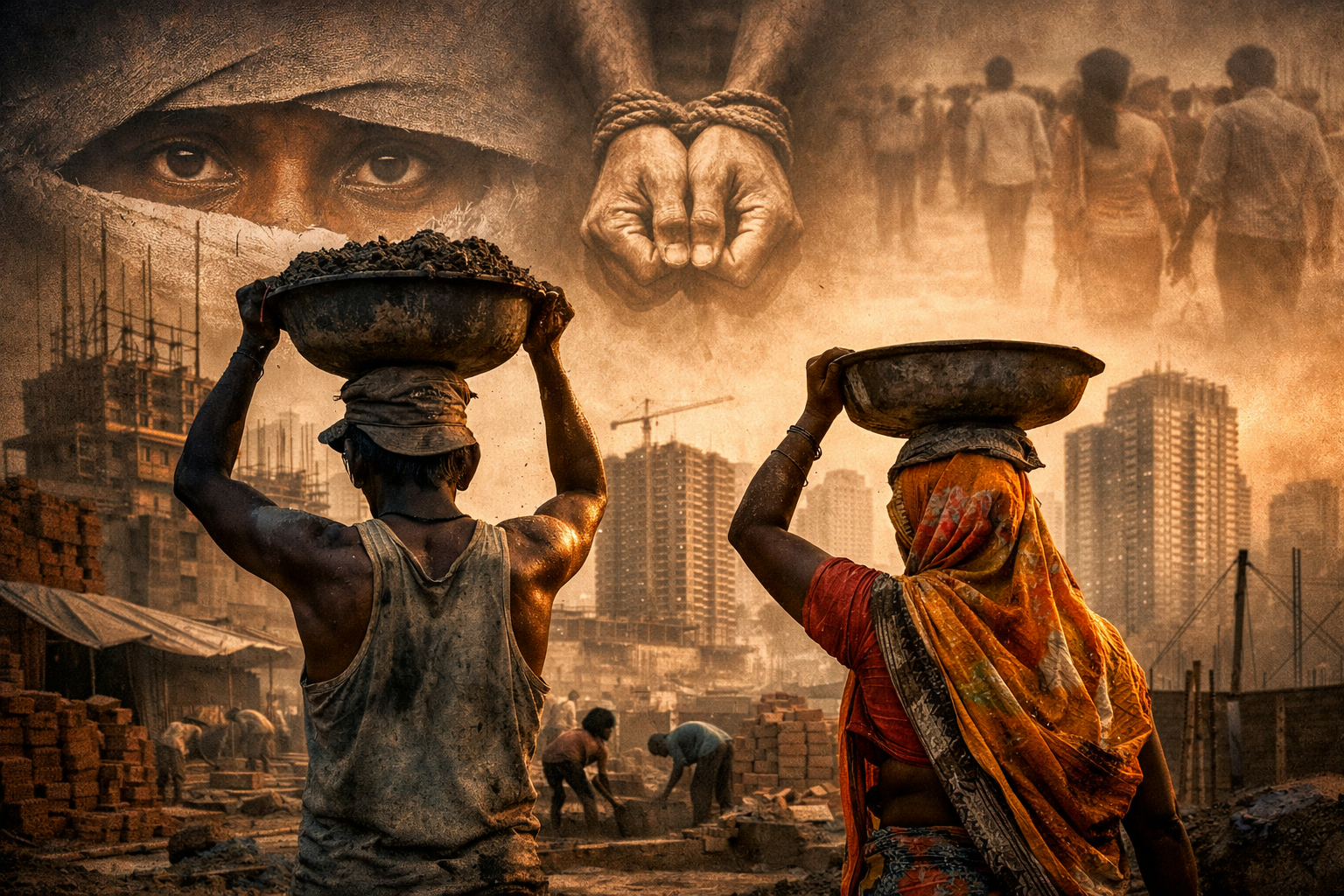
Construction workers are physically visible but socially invisible.
Urban residents interact with them without fully acknowledging their realities.
Language contributes to this distancing. Workers become “manpower” rather than individuals.
Responsibility is diffused across:
- Developers
- Contractors
- Government agencies
- Consumers
When everyone shares responsibility, no one feels accountable.
Comparisons to worse rural conditions justify current exploitation. Improvement is seen as a privilege rather than a right.
Spatial segregation reinforces psychological distance. Workers live in temporary settlements separate from middle-class housing, limiting empathy and connection.
Selective Media Attention
Media coverage focuses on dramatic incidents but rarely sustains attention.
During COVID-19, migrant workers briefly became visible. Sympathy increased. But attention faded once normalcy returned.
Society demonstrates the capacity to recognize injustice—and the ability to forget it quickly.
The Limits of Empathy
Empathy responds to stories, not statistics. Chronic suffering becomes background noise.
Social hierarchies further reduce empathy. Workers may be seen as belonging to a different social category.
Empathy becomes temporary emotional relief rather than a catalyst for systemic change.
Reframing Accountability
Accountability is distributed across workers, employers, the state, and society.
Workers are not purely passive victims. Some participate in informal hiring networks that replicate exploitative practices.
Employers operate within incentives that reward informality.
The state creates laws but lacks enforcement capacity.
Society benefits from cheap labor while remaining psychologically detached from its consequences.
Informality benefits many actors simultaneously.
This diffusion of responsibility ensures systemic persistence.
Everyone is responsible. Therefore, no one is.
Toward a Framework of Mutual Accountability
Meaningful reform requires structural transformation:
- Formal hiring systems
- Simplified worker registration
- Accessible welfare delivery
- Strong enforcement mechanisms
- Worker education and awareness
Formality must become easier than informality.
Protection must exist in practice, not only in policy.
Accountability must be structural, not symbolic.
Conclusion
India’s construction sector reveals how psychological adaptation, institutional design, and societal norms interact to sustain structural neglect.
Workers adapt to survive. Institutions perform protection without delivering it. Society benefits while remaining detached.
The system persists not because it is invisible, but because it is psychologically normalized.
Understanding these mechanisms is essential.
Because meaningful change requires transforming not only policies—but perceptions.
10 key focus points
1. Psychological Adaptation Sustains Exploitation
Construction workers psychologically adapt to harsh conditions through coping mechanisms like resilience, fatalism, and normalization, which allows structural neglect to persist without resistance.
2. Survival Mindset Limits Long-Term Planning
Scarcity reduces cognitive bandwidth. Workers prioritize immediate survival (daily wages) over long-term benefits like insurance, pensions, or legal protections.
3. Learned Helplessness Reduces Resistance
Repeated exposure to exploitation and failed institutional support creates learned helplessness, where workers stop attempting to improve their conditions because they believe change is impossible.
4. Informality Is Structurally Incentivized
The construction sector operates largely outside formal systems because informality benefits contractors, developers, and institutions by reducing costs, liability, and accountability.
5. Welfare Systems Exist More in Form Than Function
Although welfare boards have collected massive funds, bureaucratic barriers, poor enforcement, and administrative inefficiencies prevent benefits from reaching most workers.
6. Invisibility of Death and Injury Enables Neglect
Most worker deaths and injuries go undocumented due to lack of registration, informal settlements, and private compensation, preventing public awareness and systemic reform.
7. Social and Psychological Distance Reduces Empathy
Spatial segregation, class divisions, and language (e.g., “labor” instead of “people”) psychologically distance society from workers, making their suffering easier to ignore.
8. Diffusion of Responsibility Prevents Accountability
Responsibility is spread across contractors, developers, government, and society, allowing each actor to avoid direct accountability while benefiting from the system.
9. Institutional Performance Prioritizes Appearance Over Delivery
Government systems often focus on metrics like registrations and announcements rather than actual welfare delivery, creating the illusion of protection without real impact.
10. Structural Change Requires Psychological and Institutional Reform
Improving worker conditions requires not only stronger laws but also changes in institutional incentives, social perceptions, worker awareness, and enforcement infrastructure.
Disclaimer: –Disclaimer: –The information provided on this website is for general informational and educational purposes only; Involves Content assistance and structuring supported by AI tools. It does not constitute legal advice and should not be relied upon as such. Accessing or using this website does not create a lawyer-client relationship.