From Complaint to Courtroom: Investigation Process, Caveats, Bail, and Legal Petitions in Indian Law (Complete Guide)
Introduction: Understanding the Indian Criminal Justice Process
The Indian criminal justice system follows a structured legal framework governed primarily by the Code of Criminal Procedure, 1973 (CrPC). The journey from filing a complaint to courtroom proceedings involves several crucial stages, including FIR registration, investigation, bail, cognizance, and judicial review.
Understanding these procedures is essential for both accused persons and victims, as it ensures protection of legal rights, procedural fairness, and access to justice.
This guide explains the investigation process, caveats, bail provisions, closure reports, and legal petitions in India in a clear, website-friendly format.
1. FIR: The Starting Point of Criminal Investigation
The criminal investigation officially begins with the filing of a First Information Report (FIR) under Section 154 CrPC.
What is an FIR?
An FIR is a written document prepared by police when they receive information about a cognizable offence.
Types of offences:
Cognizable offences:
- Serious crimes such as murder, rape, theft, cheating
- Police can:
- Register FIR without court permission
- Arrest without warrant
- Start investigation immediately
Non-cognizable offences:
- Less serious offences such as defamation or minor assault
- Police require Magistrate’s permission before investigation
2. Investigation Process After FIR Registration
Once the FIR is registered, police initiate investigation under Sections 156 and 157 CrPC.
Key steps in investigation include:
- Collection of evidence
- Examination of witnesses (Section 161 CrPC)
- Search and seizure (Sections 165–167 CrPC)
- Arrest of accused (Section 41 CrPC, if necessary)
- Documentation of findings
After completing investigation, police submit a final report under Section 173 CrPC.
3. Bail and Cognizance: Critical Legal Safeguards
Bail protects the personal liberty of the accused while ensuring their presence during investigation and trial.
Types of Bail in India:
1. Anticipatory Bail (Section 438 CrPC)
- Applied before arrest
- Used when a person fears arrest
2. Regular Bail (Sections 437 and 439 CrPC)
- Applied after arrest
- Granted by Magistrate or Sessions Court
What is Cognizance?
Cognizance is the stage when a Magistrate officially recognizes an offence under Section 190 CrPC.
The Magistrate may:
- Issue summons
- Issue warrants
- Order further investigation
- Dismiss complaint
This stage formally brings the matter into judicial scrutiny.
4. Caveat Petition: Protection Against Ex Parte Orders
The doctrine of caveat is governed by Section 148A of the Code of Civil Procedure, 1908.
What is a Caveat?
A caveat is a preventive legal notice filed by a person who expects another party to file an application against them in court.
It ensures:
- The court cannot pass orders without hearing the caveator
- Protection against ex parte (one-sided) orders
- Upholding the principle of natural justice (right to be heard)
Where Caveats Are Commonly Used:
- Domestic violence cases
- Property disputes
- Maintenance proceedings
- Family disputes
The Supreme Court of India has emphasized that caveats protect individuals from adverse orders passed without their knowledge.
5. Legal Petitions Filed by the Accused
The accused has the right to file several petitions during criminal proceedings.
Common petitions include:
Anticipatory Bail Petition
Includes:
- FIR details look
- Grounds for bail
- Assurance of cooperation
- No criminal history
Regular Bail Petition
Filed after arrest and includes:
- Grounds for release
- Lack of evidence
- No risk of absconding
Other petitions:
- Quashing petition
- Discharge application
- Appeal petitions
These petitions must include affidavits, identity documents, and supporting evidence.
6. Legal Petitions Filed by Victims
Victims also have several legal remedies available.
Important victim petitions include:
Application under Section 156(3) CrPC
Filed when police refuse to register FIR.
The Magistrate can order police to:
- Register FIR
- Conduct investigation
Protest Petition
Filed when victim disagrees with closure report.
Other petitions include:
- Bail objection petitions
- Compensation applications
- Protection petitions
These petitions ensure victims receive justice and protection.
7. Final Report, Charge Sheet, and Closure Report Explained
After investigation, police file a final report under Section 173 CrPC.
Types of Final Reports:
Charge Sheet
Filed when sufficient evidence exists.
This leads to:
- Trial against accused
- Formal criminal proceedings
Closure Report
Filed when:
- Evidence is insufficient
- Complaint is false
- Matter is civil in nature
Magistrate’s powers regarding closure report:
The Magistrate may:
- Accept closure report
- Reject closure report
- Order further investigation
- Take cognizance independently
Importantly, the complainant must be heard before closure report is accepted.
8. Criminal vs Civil Remedies in Private Disputes
Many disputes can fall under civil or criminal law depending on facts.
Examples:
Cheating cases:
Criminal remedy:
- Criminal complaint for cheating or breach of trust
Civil remedy:
- Suit for recovery of money
Property disputes:
Civil remedies:
- Suit for declaration
- Injunction
- Possession
Criminal remedies:
- Complaint for trespass or intimidation
Domestic disputes:
- Domestic Violence petitions
- Maintenance petitions
The choice depends on facts, legal strategy, and desired outcome.
9. Importance of Judicial Oversight in Criminal Investigation
The judicial system ensures fairness through:
- Review of police investigation
- Bail hearings
- Cognizance review
- Protection of victim and accused rights
Judicial oversight prevents misuse of police powers and ensures justice delivery.
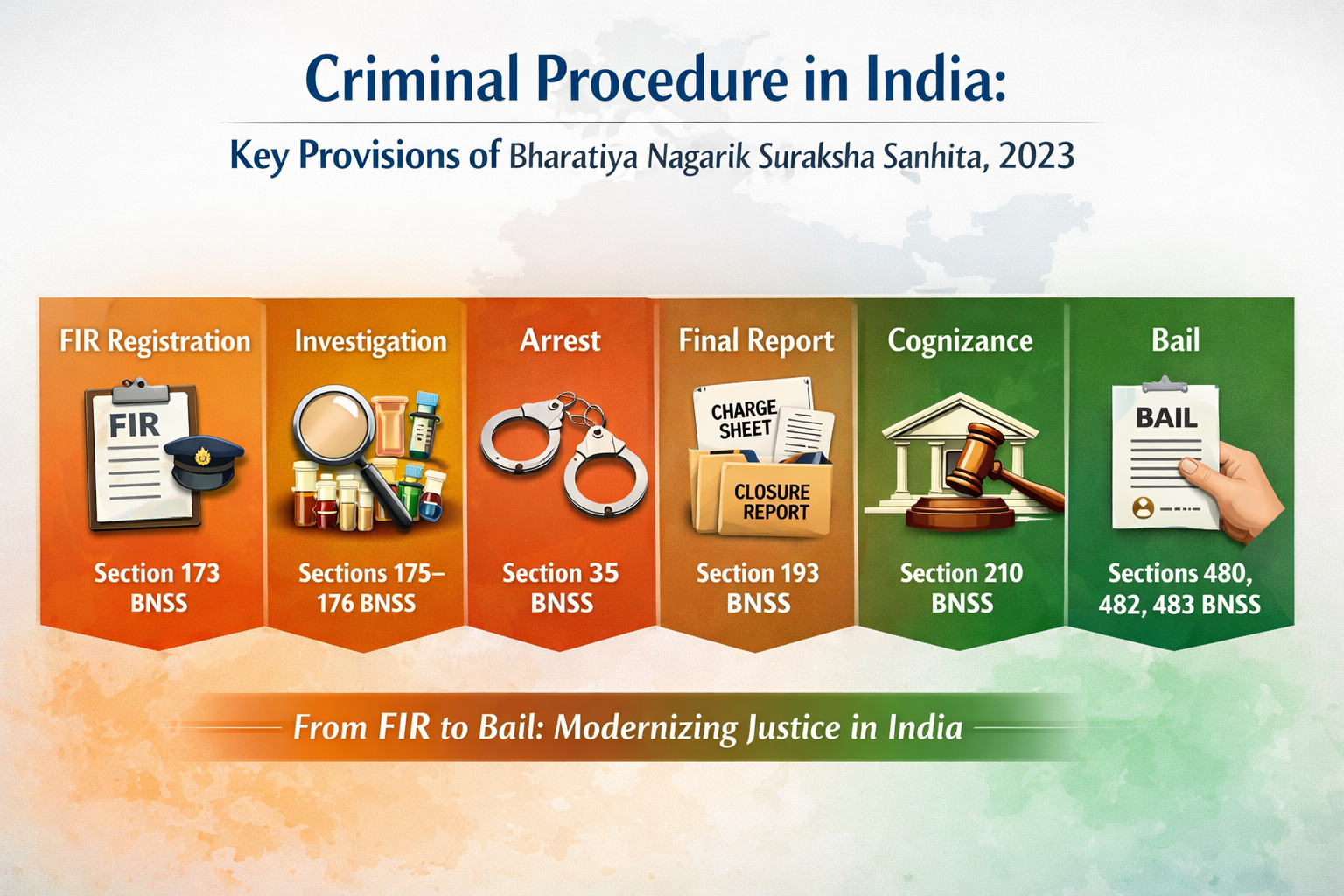
With the enforcement of the Bharatiya Nagarik Suraksha Sanhita, 2023 (BNSS), the procedural framework governing criminal investigation, arrest, bail, and judicial cognizance in India has undergone substantial modernization. The registration of a First Information Report (FIR), previously governed by Section 154 of the CrPC, is now provided under Section 173 of the BNSS, which also incorporates provisions for electronic FIR registration and acknowledgment to the informant. Investigation procedures, earlier covered under Sections 156 and 157 CrPC, are now addressed under Sections 175 and 176 BNSS, empowering police officers to investigate cognizable offences while introducing safeguards such as mandatory forensic investigation in serious offences. The powers relating to arrest, earlier under Section 41 CrPC, are now contained in Section 35 BNSS, emphasizing necessity, proportionality, and documentation of arrest. Witness examination, search, and seizure procedures are provided under Sections 180 and 185 BNSS, reflecting integration of digital evidence and videography. Upon completion of investigation, the police must submit a final report under Section 193 BNSS (corresponding to Section 173 CrPC), which may take the form of a charge sheet or closure report. Further, the Magistrate’s power to take cognizance of offences, earlier under Section 190 CrPC, is now governed by Section 210 BNSS. The provisions relating to bail have also been reorganized, with anticipatory bail under Section 482 BNSS and regular bail under Sections 480 and 483 BNSS. These reforms collectively aim to ensure transparency, efficiency, technological integration, and protection of procedural rights of both the accused and the victim, thereby strengthening the criminal justice system in line with contemporary legal and constitutional standards.
Incase, You wish to discuss, and talk on any such matter that, ‘You may need help with‘. Feel free to contact our team at https://legalwellbeing.in/contact-us/ who shall be happy to assist. Written by Team Member(s).
10 Key Takeaways
- FIR is the starting reminding step of criminal investigation in India.
- Police can arrest without warrant in cognizable offences but require permission in non-cognizable offences.
- Investigation involves evidence collection, witness examination, and final report submission.
- Bail protects personal liberty and can be anticipatory or regular.
- Cognizance is when a Magistrate officially recognizes an offence.
- Caveat petitions protect individuals from ex parte court orders.
- Both accused and victims can file various legal petitions during criminal proceedings.
- Police may file a charge sheet or closure report after investigation.
- Magistrate reminded not bound by police findings and can order further investigation.
- Civil and criminal remedies can coexist depending on the nature of dispute.
References
- Gupta, A. K., Cognizance, Investigation & Bail under CrPC, NLU Delhi Law Review, Vol. 4, 2021, pp. 120–143.
- Singh, N. & Bhatia, P., Cognizance and Bail: Emerging Trends in Criminal Procedure, All India Criminal Law Review, 2020, pp. 15–40.
- Mehta, S., Role of Magistrate: From Summons to Cognizance, Indian Journal of Gender Law, 2022, pp. 45–66.
- Shree, B. S., Emergence of Caveat in Quasi-criminal Jurisprudence, National Journal of Criminal Law, Vol. 3, No. 2, 2022, pp. 65–85.
- Tripathi, S., Caveat and Audi Alteram Partem: Doctrine in Indian Law, Theoretical Criminology Review, 2024, pp. 1–25.
- Sri V. Sethuraman v. Rajamanickam, (2009) 5 SCC 153.
- Joshi, N., Practical Elements of Judicial Petitions in Crime Cases, NLU Mumbai Law Journal, 2022, pp. 80–105.
- Das, M., Documentary Essentials in Bail & Complainant Petitions, Indian Journal of Constitutional Law, 2022, pp. 200–220.
- Bhagwant Singh v. Commissioner of Police, AIR 1985 SC 1285.
- Adhikari, N. K., Private Party Disputes in Indian Law, International Journal of Humanities & Law, Vol. 4, No. 1, 2022, pp. 80–100.
- Mehta, S., Domestic Disputes: Petitioning Under DV Act and CrPC, Indian Journal of Gender Law, 2023, pp. 120–145.
- Joshi, N., Criminal Complaint vs Civil Suit: Procedural Square-off, NLU Mumbai Law Journal, 2023, pp. 105–130.