INTRODUCTION
Every Indian understands social rules. They do so long before they even hear the word law. Long before textbooks or courtrooms even emerge as concepts for us, we learn that the line outside a ration shop only matters until someone’s uncle arrives. Or that saying “thoda dekh lijiye” works better than demanding answers. We learn which desks to avoid, which forms to carry twice, and which questions not to ask. We learn that insisting on fairness can slow things down, while adjustment keeps things moving. None of this is written anywhere, yet everyone knows it. How? This is social engineering built into everyday life. And this invisible informal training shapes our everyday life.
In our country, social engineering grows slowly, inside every home where children are taught not to interrupt elders, inside classrooms where authority is rarely questioned, and inside offices where knowing the right person often matters more than knowing the right rule. It appears clearly in the rituals people perform before visiting a government office. Extra photocopies are made. Clothes are chosen carefully. These lessons are passed down like survival wisdom. No one names them. But surprisingly, everyone understands them. This system helps people move through crowded and complicated structures. It teaches patience and negotiation. It teaches how to get things done without friction. But it also teaches people that systems are merely meant to be managed. This is precisely where the misfortune starts. Delays become normal, Confusion feels expected. Silence begins to feel safer than asking questions. Slowly, this is how it works” becomes the chant of the people and the curiosity to delve into the system fades.
Nowhere is this belief more deeply rooted than in our relationship with law.
Yes, law. Contrary to popular belief that it just exists in summons, or thick files, or courtroom, law is ever-present in the smallest and the most ordinary moments, too. Somewhere in the country, someone may be going bankrupt because of an agreement they never fully understood. Somewhere else, a family is sitting across a table from a legal advisor, hoping to protect a lifetime of savings. A tenant hesitates before speaking up or an employee works unpaid overtime without complaint. Law moves through all these moments without explicitly announcing itself. It shape shifts into losses, protections, and futures while remaining subtle. It is do, so deeply woven into the fabric of our society (the world, for that matter) that separating it from daily life is nearly impossible. And yet, many people do try this (heroic) act. They choose to believe that law exists only inside the courtroom, police stations, and legal offices. They look away because they cannot see its wheels turning right in front of their eyes. But law works much like the foundation of a building. You do not see it every day, but it holds up everything. Ignoring its presence only ends up weakening our position within it. This distance between people and law has been carefully shaped over time. The same social habits that teach respect for authority also teach fear of systems. Legal language feels unfamiliar. Procedures feel exhausting and courts feel intimidating (and slow). Over time, this law stops feeling like a shared resource and begins to feel like someone else’s domain, something to approach only when there is no other choice left. But law was never meant to live at a distance from people to begin with. It itself grows directly out of social realities. Labor laws were born from everyday exploitation. Family laws emerged from lived relationships. Environmental laws came from shared damage. Society shapes law, and law reshapes society in return. They are not separate worlds moving in parallel. They are like two circles in a venn diagram, constantly overlapping, with society living in the space where they meet. It is in this shared ecosystem that everyday life becomes, shapes, and continues.
This is also where legal wellbeing begins.
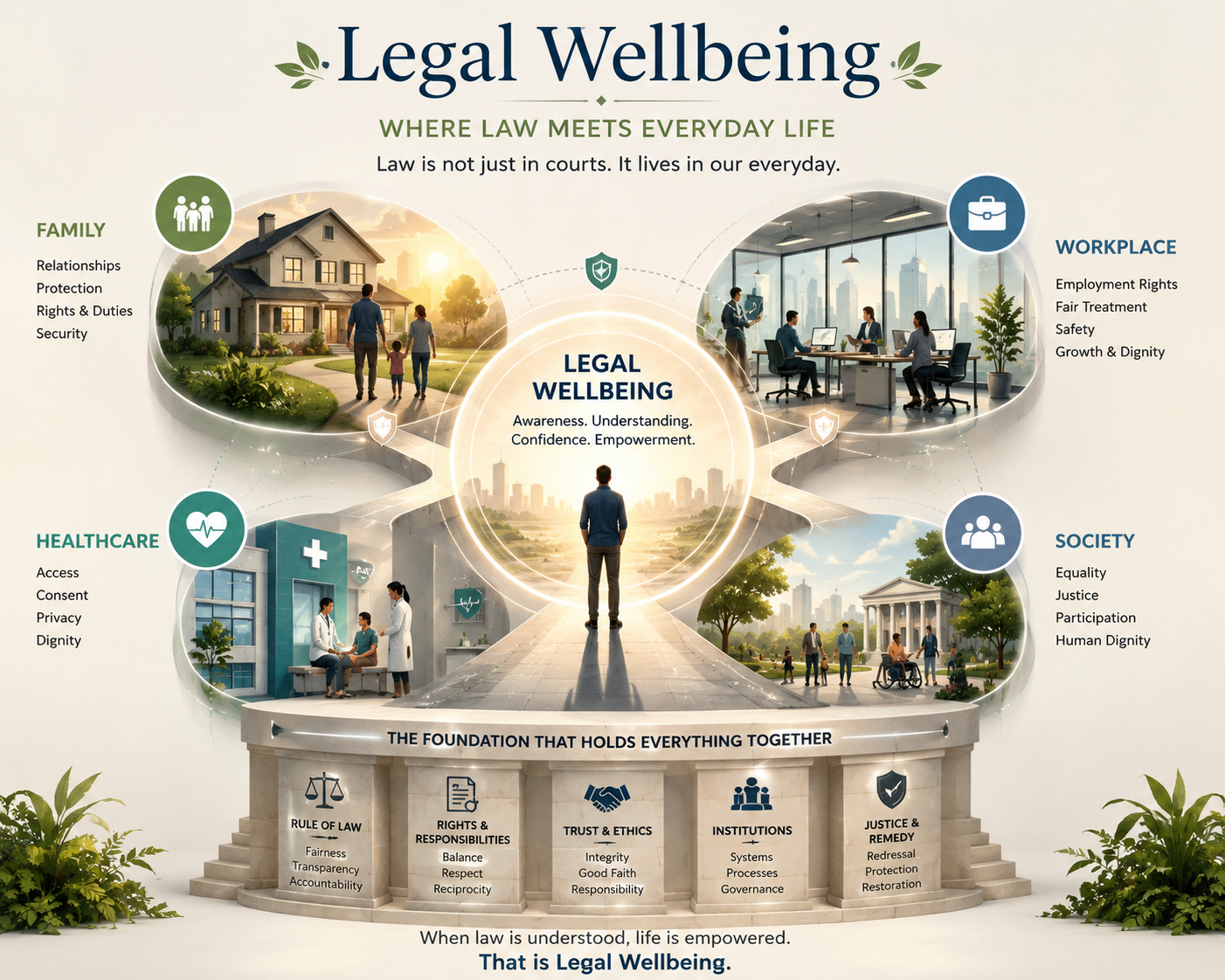
Legal Wellbeing is about restoring a healthy relationship between people and the systems that govern their lives. It is about replacing fear with understanding, avoidance with awareness, and silence with informed choice. When people begin to see law as part of everyday life, things start to change. Engagement becomes possible. Legal well-being recognises that law is already present in every walk of life. The question is not whether it exists, but whether we meet it consciously or let it operate without us. It becomes possible when law meets psychology, which brings forth the unique mixture of legal existence in spaces of human behavior. It lives in how people perceive the authority, how fear shapes silence, how confidence enables action, how the law is interpreted by each unique individuals, and how past experiences decide whether someone seeks help or withdraws. Law may provide structure, but psychology explains how people actually experience that structure. And when we look at legal wellbeing through this lens, the focus shifts and changes. The question is not longer solely what the law says, but how people understand it, feel about it, and respond to it. Many answers lie in a place whether beliefs, conditioning and social learning is built over time which legal text cannot answer satisfactorily. At least, not alone. The intersection, thus, becomes about understanding everyday people navigating everyday systems. It recognises fear, trust, habit, and confidence play as much a role in justice as rules and procedures do. Legal well-being is then a human condition which exists when systems are designed with an understanding of how people think, and when people are supported to engage with law without fear or confusion.
The Four Pillars of Wellbeing in India
In India, law is not something that exists only inside the legal realm of courts and books. It is present in everyday life as well: when a worker asks for unpaid wages, when a woman walks into a police station, or when a student signs an admission form without fully understanding it. Law is something that quietly shapes how people live, even when they do not notice it. For a society to function healthily, law must support people rather than confuse or frighten them. The idea of support can be understood through four connected pillars that are in existence: the system, the individual, the organization, and society.
The legal system is the foundation on which everything else stands. This system was created to protect the people and maintain the balance. But reality is a far cry from this; most people are often overwhelmed by it. Over time, it has grown more complex, too. Rules have multiplied, language has become difficult, and processes have slowed down. A healthy legal system should be easy to approach without making a person feel small or incapable. When someone seeks help, they should not feel embarrassed to ask questions or punished for not knowing procedures. Law works best when it treats people with dignity. Another important feature of a strong system is its ability to change with society. Today’s India is very different from India fifty years ago. Families, workplaces ,technology, and social values have changed, and law needs to evolve along with them. When laws refuse to adapt, they stop serving the people. A system that listens, learns, and improves remains alive. Transparency also matters deeply. When laws and procedures are explained clearly, people trust them more. Confusion creates fear, but understanding creates confidence. Finally, a good system provides clear ways to fix harm. When something goes wrong, people should know where to go and what steps to take. Justice should feel possible, not endless.
While the system is important, it does not work alone. The individual plays an equally powerful role. In a democracy like India, citizens hold great power, yet many people do not feel powerful at all. This happens because legal processes often seem too complicated. People hear stories of delays, corruption, and rejection, and slowly they begin to believe that their efforts will not matter. Over time, this feeling turns into silence. People stop asking questions and accept unfairness as normal. This loss of belief is not due to lack of intelligence or courage. It comes from repeated experiences where voices are ignored. Many institutions speak about citizens’ rights, but their actions make people feel helpless. Problems are often described as too large for one person to change. As a result, individuals forget that every large change starts small.
Real change begins when even one person decides to act with awareness. When someone chooses to read the rules, file a complaint correctly, or ask why a procedure exists, they break the cycle of silence. This single action can influence others. Family members learn. Friends ask questions. Slowly, confidence spreads. When people see that legal engagement is possible, they feel encouraged to try. An individual who understands their legal position is not just seeking help for themselves. They are showing others that participation is allowed. Between the individual and the larger society stand organizations. These include schools, offices, non profit groups, hospitals, housing societies, and local institutions. Organizations shape how people experience law in daily life. When an organization follows rules honestly and explains them clearly, it creates a sense of safety. People learn that law does not exist only to punish, but also to guide. Organizations have a responsibility to build understanding rather than dependency. When legal knowledge is shared openly, people grow more confident. When it is hidden, people remain afraid and dependent. Ethical organizations explain rights and duties in simple language. They help people understand choices rather than forcing decisions. In doing so, they become reliable points of support within communities.
As these three pillars interact, society begins to change. Society is not separate from the system or individuals. It is the result of their daily interactions. A society with legal well being is one where people do not panic when legal issues arise. Instead, they know how to respond calmly. Knowledge is spread across communities, not locked inside offices or limited to experts. Asking legal questions becomes normal, not shameful. Such a society also thinks about the future. Laws are not made only for present comfort but for long-term fairness. Children grow up seeing adults engage with systems rather than fear them. Over time, confidence replaces confusion. Trust replaces silence.
Legal wellbeing as a culture and a lifestyle
Legal wellbeing should be understood as something that appears only during times of conflict or crisis. It must be seen as something that exists in our everyday life, through habits, conversations, and attitudes. Over time, it molds how people think, decide, and live. When that happens, legal well-being stops being a distant concept and becomes a blend of culture and lifestyle. And this very blend is what shapes behavior across families, communities, and generations.
As a culture, legal well-being influences how people learn to relate to the law from a young age. In many households, children grow up hearing that courts are frightening places and that police stations should be avoided unless something has gone terribly wrong. Law is spoken about in whispers, wrapped in fear or mistrust. This kills the very essence of nature and the need for law to exist. We start to fear something that was put in place to assist us. When legal well-being becomes part of culture, that fear slowly fades. Understanding rights and responsibilities starts to feel as normal as learning how to cross the road safely or how to speak politely. People just need to realize that being amateur is okay; all they need to know are the basics to begin with, because that knowledge is openly shared. In such communities, law is no longer seen only as punishment or protection. It is understood as a shared tool that is designed to help people live together fairly.
Legal wellbeing simultaneously shows up in lifestyle as well. It shapes how people move through daily life, much like financial or physical well-being does. Instead of reacting only when something goes wrong, people begin to engage with the law proactively. They read documents before signing them. They ask questions instead of assuming. They keep records, not because they expect trouble, but because preparedness feels natural. This lifestyle reflects conscious decision-making. Choosing a workplace, renting a house, starting a business, or even navigating relationships are all choices that are made with a basic awareness of rights and boundaries. Therefore, we strive for that clarity. One person’s awareness affects their family, their workplace, and their community. When individuals practice legal awareness consistently, it strengthens collective norms. And when those norms exist, they make it easier for individuals to stay informed and empowered.
Social Engineering & legal wellbeing
Every society has engineered itself one way or the other. The rules we follow, the behaviors we reward, the systems that we trust, all of these shape how people live together. Traditionally, the way law has built itself works from the top down approach. Laws are drafted, imposed, enforced, and people are simply expected to adjust. On the contrary, legal well-being invites a quieter and a far more sustainable shift to this approach. This proposed that social engineering of law needs to begin from the bottom up. Change need not be forced through institutions alone, but grows through empowered individuals who understand their rights, responsibilities and choices. When people are legally aware, systems do not need to rely solely on fear or punishment to function. They begin to work because people participate in them with intention. It also asks us to rethink what legal systems are designed for. Instead of being structured primarily around compliance and correction, they can be shaped around human flourishing. This means laws that are easier to understand, less intimidating processes, and institutions that recognise emotional, psychological, and social realities. A system that supports well-being before something breaks is far more humane than one that intervenes only after harm has occurred. This creates a natural feedback loop. When people feel supported rather than threatened by the law, they engage more honestly with it. Their lived experiences, challenges, and needs then inform how laws evolve. Society shapes law, and law reshapes society. These two keep constantly adjusting to each other rather than pulling apart.
Zooming out, this shift fits into a much larger pattern we are beginning to see globally. Human organisation has always revolved around a central priority. First, it was survival. Lead into productivity. And finally, consumption. Today, we are slowly moving toward a new center of gravity, i.e., well-being. And this shift is inevitable. As material needs are met for larger sections of society, attention naturally moves to the quality of life. At the same time, there is a growing recognition that economic growth without psychological, social, and legal wellbeing creates quiet suffering. Burnout, distrust in institutions, and social fragmentation are all signs of this imbalance. There is also a deep awareness now that individual well-being cannot exist in isolation. One person’s safety, dignity, and access to justice are tied to the well-being of the collective.
Another significant truth about law and society is that neither of them can afford to stand still. They are not constants but living forces, shaped by time, behavior, and belief. When one moves, and the other refuses to, something begins to crack. This is where regression begins. When law remains unchanged while society evolves, the damage is often subtle at first. Rules that once felt protective begin to feel suffocating. Legal frameworks designed for another time are applied to present-day lives, creating injustice without ever announcing it loudly. Outdated laws stop liberating people and start controlling them. Gradually, citizens stop seeing the law as something that works for them and begin viewing it as a distant authority that limits rather than enables. Trust erodes simply because the law no longer feels alive.
The opposite is just as dangerous. When society remains rigid while the law tries to evolve, stagnation sets in. Social norms are bound to resist change because we as a species resist change. On this note, legal progresses find no ground to stand on. Law may exist on paper, but it fails to take root in real lives. Innovation in legal environments, the range of what people can imagine for themselves, then, tends to shrink.
True progress can only happen when society and law evolve together. And this parallel evolution is not about perfect balance. It is about movement. Law responding to how people actually live, and people reshaping their behavior as legal possibilities expand. Social shifts push the law to adapt, while legal changes create room for society to grow into something farrier and more humane.
LAW AS A TOOL (THE UNEQUAL ACCESS AND THE PROMISE OF LEGAL WELLBEING)
Law is meant to be a tool at its core. As a tool, it needs to work as a way for society to organize itself, distribute power, and create possibilities for the people of the society. Like any tool, its effectiveness also depends on various things. Having access to it, understanding how to use it, living in conditions that allow its use, and feeling culturally permitted to wield it are a few to name. Without these, the law risks being more of a weapon than a safeguard. More of a barrier than a bridge.
In India today, the distribution of this tool is far from equal. Quality legal assistance often sits at the gate of economic privilege. Legal literacy remains a specialized knowledge, accessible only to those who seek it or can pay for it. Cultural conditioning teaches some communities that law is an adversary to fear rather than a resource to use. Even the design of institutions can exclude rather than include, making participation feel complicated or impossible. The result is predictable: power concentrates in the hands of those with access, injustice spreads silently through ignorance, and democratic engagement becomes restricted to those equipped to navigate legal systems. Society as a whole suffers when large portions of people cannot engage meaningfully with the law that shapes their lives. Legal well-being reframes this problem. It treats access, knowledge, and cultural understanding not as privileges, but as basic infrastructure like roads, schools, or public healthcare. Communities can build legal literacy as a shared resource, not a secret held by experts. Every day, people can develop the confidence to handle routine legal questions and know when and how to seek specialized help. This demystification allows law to function as a tool for everyone, rather than only for those already empowered. Redistribution of legal capacity is both practical and cultural. It requires teaching, sharing, and embedding legal understanding into daily life. It means reframing law from a distant authority into a lived, approachable presence. The goal is not to erase expertise or the role of lawyers, but to ensure that basic legal tools and awareness are universally available, so people can act, decide, and participate with clarity and confidence.
The Citizen as a Powerful Entity
At the heart of every democracy sits the simple idea that the citizen is the smallest unit of power. And yet, modern citizens rarely feel powerful. Most of us experience law as something that happens to us, not something we participate in shaping. We become spectators to our own social reality, watching systems move while assuming we cannot move them in return. Legal well-being challenges this assumption at its root. It does not begin with the hope that everyone will wake up at once. It begins with a quieter, more realistic truth: meaningful societal change often starts with one person who decides to act differently.
When a single individual develops legal awareness by understanding their rights, asking questions instead of retreating, engaging rather than avoiding, the shift is not just internal. It becomes visible. That person handles disputes differently. Makes decisions with more confidence. Speaks with less fear. Slowly, people around them notice. Family members ask questions. Friends observe outcomes. Colleagues rethink their own silence. Without intending to, the individual creates a template that empowered legal engagement is possible in everyday life. This is how movements actually begin. One person’s small success builds legitimacy. Legitimacy invites imitation. Imitation builds momentum. And momentum, over time, reshapes culture. The greatest obstacle to this process is desensitization. Years of delays, complexity, and intimidation train people to believe effort is futile. Over time, disengagement feels safer than hope. Legal well-being works by gently reversing this conditioning. It starts with micro-victories: small, winnable engagements that restore a sense of agency. It grows through shared stories of ordinary people navigating legal systems without extraordinary power or privilege. It strengthens through skill-building, where legal literacy feels practical rather than abstract. And it survives through community witnessing, where individuals are supported, believed, and validated when they try. Failure, too, is reframed as part of learning how systems respond. History reminds us that every major social shift began with a handful of people refusing to accept silence as inevitability.
In the framework of legal well-being, the citizen is neither a passive recipient of legal services nor an adversary of the system. They are participants. A co-creator. Someone whose everyday choices quietly influence how law lives in society.
THE FOUNDATIONAL ROLE OF MENTAL WELLBEING
Legal Wellbeing does not begin with laws. It begins with the people who are the core cogs of its wheels. More specifically, it begins with the mental and emotional state of the people expected to engage with those laws. The ability to read a notice without panic, to ask a question without fear, to wait through a process without giving up, or to assert a right without feeling small are not legal skills alone. They are mental ones.
Yet modern society treats mental wellness as a private concern, something to be handled quietly, individually, and often invisibly. Legal systems, on the other hand, are designed as if every citizen arrives calm, confident, informed, and emotionally steady. This mismatch creates one of the most overlooked gaps in justice today. Engaging with the law demands mental resources. It requires attention to detail, the ability to process unfamiliar language, and the patience to navigate slow or complex systems. It demands emotional regulation, because legal processes often trigger fear, frustration, shame, or helplessness. Most importantly, it requires self-belief, the quiet conviction that one’s actions matter and that speaking up is worth the effort. When mental wellness is compromised, these capacities weaken. This makes silence and avoidance of the situations easier.
This should be viewed as a structural blind spot.
When we look at it closely, we realise that we live in a strange paradox. Awareness of mental health has never been higher, yet the declining mental health feels widespread and persistent. Instead of changing the conditions that exhaust people, overwhelm them, or keep them in constant survival mode, society often chooses quicker responses: medication without reflection, productivity without rest, and resilience without support. In doing so, we allow the deeper crisis to pass through us unaddressed. The consequences quietly spill into the legal realm. People delay dealing with contracts, disputes, or documentation until problems escalate. Stress clouds judgment, leading to decisions that worsen legal outcomes. Emotional vulnerability increases susceptibility to exploitation, whether by predatory agreements or misleading advice. When mental distress remains unaddressed, it also travels across generations. Children raised in environments shaped by fear or instability grow up less equipped to engage confidently with systems meant to protect them. Progress, at every level, depends on mental wellness. An individual cannot meaningfully use their rights while mentally overwhelmed. An organisation cannot build a culture of legal empowerment when its members are burned out or emotionally unsafe. A society cannot expect law and social change to evolve together when collective mental health is fragile.
This is also where the concept of legal well-being offers a deeper framework. It asks us to stop treating mental wellness as separate from legal capacity. It invites legal systems to become trauma-ware, recognizing how past experiences shape present engagement. It encourages a wellness-first approach, where people are supported emotionally before being expected to navigate complexity. It pushes for legal processes designed to reduce stress rather than amplify it, and for a preventive mindset that strengthens mental health long before crises appear. At its core, this integration rests on a simple truth. We cannot build well-legalized societies with mentally exhausted citizens. And we cannot expect the law to earn trust if it consistently feels like a source of distress. When mental wellness is treated as essential infrastructure rather than an afterthought, legal progress stops being abstract and starts becoming human.
PRACTICAL APPLICATIONS & FUTURE DIRECTIONS
Ideas matter only when they change how people live. Legal well-being needs to be more than just a comforting theory. It must enter daily routines, workplaces, institutions, and the public imagination. Its strength lies not in grand reform alone, but in small, repeatable practices that will slowly reshape how law is experienced.
At the individual level, legal well-being begins with attention. Just as people are encouraged to monitor their physical and mental health, legal health too needs regular check-ins. This does not mean living in constant alert or suspicion, but staying gently informed. Reading documents before signing, understanding basic rights at work or at home, and knowing where to seek help when something feels off are quite acts of self-respect. Over time, people also begin to build informal networks of support. Friends who share information, family members who have learned from past experiences, and communities that guide rather than scare. Slowly, fear-based avoidance gives way to calm engagement.
Organizations play a crucial role in this transition. Institutions shape behaviour far more than individuals realise. When workplaces, universities, housing societies, or nonprofits adopt wellness-centred legal policies, they send a powerful message: law exists to support, not threaten. Training that builds basic legal understanding across teams reduces dependency and confusion. Feedback loops between employees and legal processes allow systems to evolve instead of stagnating. Most importantly, organizations that model transparent and empowered legal engagement create ripples far beyond their walls.
Systemic change follows when enough individuals and institutions begin to act differently. Legal structures themselves must be designed with human well-being in mind. This means advocating for laws and procedures that are understandable, accessible, and responsive to lived realities. It also means supporting policies that allow law and society to evolve together, rather than pulling in opposite directions. Strong bridges between legal professionals and communities help translate expertise into usable knowledge, while accountability mechanisms ensure that legality does not drift away from legitimacy.
At the societal level, transformation is cultural. Narratives around law must shift. Law cannot remain a symbol of punishment, delay, or intimidation. It must be spoken of as a shared resource, something ordinary people can touch, question, and use. Community education strengthens collective resilience, allowing people to face disputes without collapse or silence. Spaces for legal innovation, rooted in social needs rather than abstract ideals, allow law to stay alive. And when legal confidence is passed down across generations, empowerment stops being an exception and becomes a norm.
Conclusion
Legal Wellbeing is not an aspirational vision but a practical necessity. As societies face increasing complexity, rapid change, and interconnected challenges, the traditional model of law as a specialized domain accessible only through professional intermediaries becomes untenable.
The future belongs to societies that successfully integrate legal Wellbeing as culture and lifestyle, that recognize the parallel evolution of law and society as a necessity rather than a threat, that empower citizens rather than maintain their desensitization, and that understand mental wellness as the foundation upon which all other forms of wellness, including legal, must be built. The transformation begins with recognition: every individual possesses more power than they believe, every organization can become a site of legal empowerment, every system can evolve toward wellness, and every society contains within it the seeds of its own transformation. The question is not whether legal well-being will emerge as a global organizing principle, but whether we will consciously participate in its emergence or resist until crisis forces change upon us. The choice, ultimately, belongs to individuals, multiplied across communities until it becomes the power of all. This is how legal well-being becomes a way of life: one person, one organization, one community at a time, choosing empowerment over desensitization, wellness over extraction, and evolution over stagnation.
The work begins now. The work begins with each of us.